


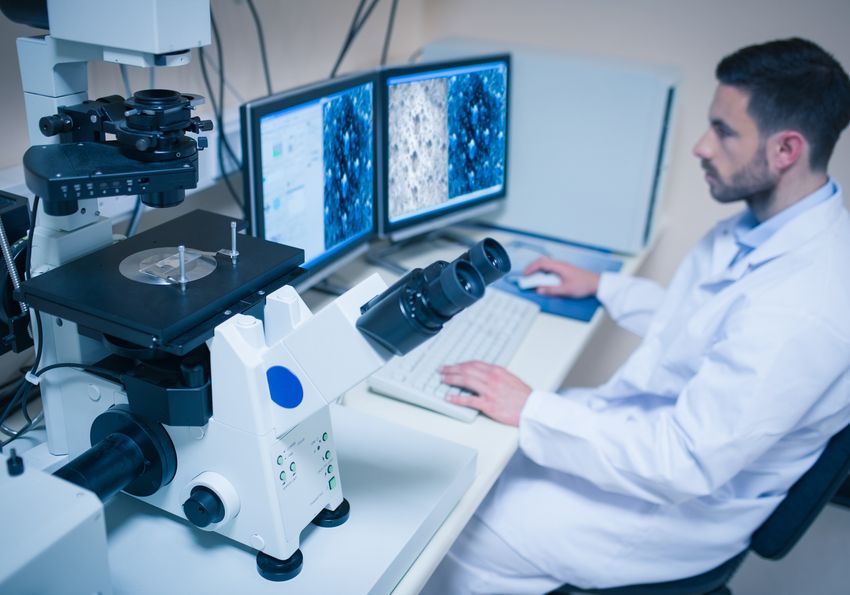
An electron microscope allows scientists to observe extremely small structures within specimens that cannot be seen with traditional light microscopes.
©iStock, Wavebreakmedia
In 1931, Ernst Ruska and his mentor, Max Knoll, from the Berlin Technische Hochschule, constructed the first electron microscope, a groundbreaking invention that revolutionized scientific imaging and paved the way for modern electron microscopy.1 This article explores the fundamental components of electron microscopy, various microscope types and their working principles, and technological advancements that expand electron microscopy’s applications.
What Is Electron Microscopy?
Electron microscopy is a powerful technique that provides high-resolution images by focusing a beam of electrons to reveal fine structural details in biological and material specimens.2 Because electrons have much shorter wavelengths than photons of light, electron microscopes can achieve higher resolution than traditional light microscopes, enabling visualization of structures at the nanometer or even atomic scale.
A basic electron microscope includes several elements, each providing a specific function necessary for effective imaging.3
- An electron gun produces the electron beam, and the condenser system focuses it onto the sample.
- The image-producing system comprises a movable specimen stage that holds the specimen and the objective and projector lenses that focus the electrons passing through the specimen to form a highly magnified image.
- The image-recording system converts the invisible electron image into a form that the human eye can perceive. Traditionally, scientists have used a fluorescent screen to convert electron energy into visible light. Today, researchers most commonly use digital charge-coupled device (CCD) and complementary metal-oxide-semiconductor (CMOS) cameras, or direct electron detectors to view electron microscopy data.
Early Electron Microscope Types
Researchers have broadly classified electron microscopy into transmission electron microscopy (TEM) and scanning electron microscopy (SEM), based on how the electron beam interacts with the sample and the type of information each technique provides.4
How the transmission electron microscope works
TEM is the earliest developed form of electron microscopy. Transmission electron microscopes produce highly detailed, 2D black-and-white images that reveal the inner architecture of biological and material specimens. This method provides structural information based on how electrons interact with molecules in a sample as the electron beam passes through the specimen.5 However, electrons have poor penetration capacity and thick specimen sections can absorb them, preventing transmission through the sample and blocking meaningful readouts. In TEM, scientists keep specimen thickness below a few hundred angstroms to avoid this problem.
During TEM imaging, researchers generate a high-voltage electron beam by heating a tungsten filament in an electron gun.5 They focus and direct the broad beam with electromagnetic lenses and apertures, allowing it to pass through an ultra-thin specimen mounted on a grid, and use a goniometer to precisely orient the specimen for optimal viewing.6
As the electron beam passes through the specimen, atoms in the sample scatter the electrons and create areas of varying contrast based on the type of atom and atomic density. This contrast forms the basis of the image. Electromagnetic lenses magnify the resulting image and project it onto a fluorescent screen for viewing or a CCD captures the contrast to create a digital image.5
TEM utilizes a high-vacuum system to prevent the electron beam from scattering due to air molecules, thereby ensuring high resolution and image quality.5 Scientists observe the final image in a monitor attached to the microscope. By actively adjusting specimen orientation and beam focus, controlling imaging conditions, and applying contrast agents such as heavy metal stains, researchers can visualize fine structures, including ribosomes, microtubules, microfilaments, and large protein molecules.7

Scanning and transmission electron microscopy help researchers view structures, such as the surface of a viral particle or organelles of a cell, at greater resolution than light microscopy.
modified from © istock.com, freehandz, ZernLiew, yotto, mariaflaya, Wiyada Arunwaikit; designed by Erin Lemieux
How the scanning electron microscope works
While SEM offers lower resolution compared to TEM, it allows scientists to examine much larger samples with significantly greater depth of field. Scanning electron microscopes produce 3D surface images, which are crucial for analyzing the outer topography and features of various materials.8
During SEM analysis, an electron gun generates a focused beam of high-energy electrons, typically ranging from 100 to 30,000 electron volts. Electromagnetic lenses guide and narrow this beam, allowing it to systematically scan the specimen’s surface in a raster pattern.9 As the electron beam interacts with the surface, the sample reflects electrons from the beam, called backscatter, and emits new or secondary electrons for detection.
Two main detector types collect electron signals in SEM: secondary electron detectors collect low-energy electrons to produce high-detail surface topography images, while backscattered electron detectors capture high-energy electrons, helping distinguish compositional differences.8 SEM processes these electron conductivity signals to construct high-resolution images that reveal the specimen’s surface features and textures. Heavier elements reflect more electrons and appear brighter in the images. If a specimen is naturally nonconductive, researchers prepare the sample for SEM analysis by coating it with a thin layer of metal, such as gold or platinum, to improve its conductivity and prevent static charge accumulation.8
By analyzing SEM images, scientists can examine fine surface details, such as cracks, particles, and other microstructures, and gain valuable insights into the material. SEM is primarily used to analyze crystalline structure, electrical behavior, surface topography, and chemical composition in both biological and non-biological specimens.9
Table: Comparing TEM and SEM8,10
|
Feature |
TEM |
SEM |
|
Electron beam |
Broad and static |
Focused on a specific point, scanning the sample line by line 
|
|
Sample preparation process |
Often laborious sample sectioning to ensure electrons can pass through |
Simple with no strict thickness limits, nonconductive samples must be coated with a thin layer of metal (e.g., gold) |
|
Resolution |
Up to 0.2 nm |
Up to 6 nm |
|
Magnification |
Up to 5,000,000X |
Up to 150,000X |
|
Image formation |
2D |
3D |
|
Purpose |
Investigating cellular ultra-structure, organization of molecules in viruses, and protein arrangement on cell membranes |
Examining topography and surface atomic compositions |
Cryo-Electron Microscopy and Other Technological Advances
Researchers have continually adapted electron microscopy for specialized experiments, developing techniques such as cryogenic-electron microscopy (cryo-EM), correlative light and electron microscopy (CLEM), 3D electron microscopy (3D EM), low-vacuum SEM (LVSEM), and scanning transmission electron microscopy (STEM).4 These innovations have significantly advanced the understanding of glomerular disease pathogenesis and diagnosis.
Scientists typically use cryo-EM to examine radiation-sensitive specimens via TEM under cryogenic conditions. By rapidly freezing samples, researchers can preserve cellular and organelle architectures for imaging without the need for chemical fixation or staining. Cryo-EM also facilitates the structural analysis of dynamic macromolecules.11 Recent advances in microscope design, direct electron detectors (DEDs), imaging hardware, and automation have expanded cryo-EM’s applicability in biological research.12 Additionally, pairing cryo-EM with artificial intelligence (AI) prediction tools such as AlphaFold has significantly accelerated drug development by enabling faster and more accurate protein structure prediction that improves target identification and lead optimization.13
Both single-particle analysis (SPA) cryo-EM and cryo-electron tomography (cryo-ET) are rapidly evolving imaging techniques that enable researchers to visualize 3D cellular structures in their native, near-physiological state.12 These methods allow researchers to map the molecular composition of the cellular interior and visualize individual proteins and complexes at near-atomic resolution, providing unique insights into cellular organization and function.
Automation and digitalization have revolutionized cellular electron microscopy, enabling routine capture of large areas and volumes at nanoscale resolution. Researchers recently achieved unsupervised, automated extraction of biomolecular assemblies from conventionally processed tissues using large-scale hyperspectral electron microscopy.14 This approach should accelerate understanding future investigations into biological ultra-structures.
Future Electron Microscopy Outlooks
Electron microscopy holds promise for an exciting future, as researchers continually improve electron optics and detector technologies. For instance, time-resolved cryo-EM is an emerging technique in structural biology that allows researchers to visualize protein dynamics, revealing detailed images of conformational changes that occur at short timescales. This was not possible previously with standard imaging methods.15 A wider implementation of AI and automation will enable effective streamlining of data acquisition and analysis, making electron microscopy more accessible and efficient for a wider range of users. Scientists are also designing smaller and more affordable electron microscopes that will expand their application further into industry and academia.16
FAQ
What is electron microscopy used for?
- Researchers use electron microscopy to examine the fine details of both biological and non-biological specimens at the nanometer and near-atomic scale. This technique is widely employed in biology to study cellular structures, viruses, and molecular components such as proteins. Electron microscopy is also useful in material sciences and engineering, helping experts examine the structure and composition of metals, ceramics, and nanomaterials.
What is the principle of electron microscopy?
- The key principle of electron microscopy lies in using a focused beam of electrons to visualize a specimen. This allows the microscope to achieve high resolution and magnification, revealing ultrastructural details of the sample that cannot be captured with conventional light microscopy.
What are the main advantages of electron microscopy?
- Electron microscopy can reveal fine details at greater resolution than traditional light microscopy because it is not subject to the diffraction limit of light.
- Harris PJF. Transmission electron microscopy of carbon: A brief history. C. 2018;4(1):4.
- Mattsson K, et al. Monitoring anthropogenic particles in the environment: Recent developments and remaining challenges at the forefront of analytical methods. COIS. 2021;56:101513.
- Reimer L. Elements of a transmission electron microscope. In: Transmission Electron Microscopy. Springer Series in Optical Sciences.1993;36.
- Honda K, et al. Recent advances in electron microscopy for the diagnosis and research of glomerular diseases. Kidney Res Clin Pract. 2023;42(2):155-165.
- Franken LE, et al. A technical introduction to transmission electron microscopy for soft-matter: Imaging, possibilities, choices, and technical developments. Small. 2020;16(14):1906198.
- Reza M, et al. Transmission electron microscopy for wood and fiber analysis – A review. BioRes. 2015;10(3):6230-6261.
- Mielańczyk Ł, et al. Transmission electron microscopy of biological samples. InTech; 2015.
- Brodusch N, et al. Scanning electron microscopy versus transmission electron microscopy for material characterization: A comparative study on high-strength steels. Scanning. 2021:5511618.
- Ali A, et al. Mineral characterization using scanning electron microscopy (SEM): A review of the fundamentals, advancements, and research directions. Appl Sci. 2023;13(23):12600.
- Nelson BJ, et al. Micro/Nanorobots. In: Springer handbook of robotics. 2008;8.
- Murata K, Wolf M. Cryo-electron microscopy for structural analysis of dynamic biological macromolecules. Biochim Biophys Acta Gen Subj. 2018;1862(2):324-334.
- Guaita M, et al. Recent advances and current trends in cryo-electron microscopy. Curr Opin Struct Biol. 2022;77:102484.
- Zhu KF, et al. Applications and prospects of cryo-EM in drug discovery. Mil Med Res. 2023;10(1):10.
- Duinkerken BHP, et al. Automated analysis of ultrastructure through large-scale hyperspectral electron microscopy. Npj Imaging. 2024;2(1):53.
- Mäeots ME, Enchev RI. Structural dynamics: review of time-resolved cryo-EM. Acta Crystallogr D Struct Biol. 2022;78(8):927-935.
- Kuzyk C, et al. Concept and demonstration of a low-cost compact electron microscope enabled by a photothermionic carbon nanotube cathode. Nat Commun. 2025;16(1):8067.


